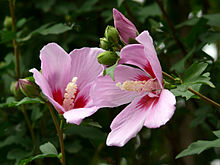
Hibiscus syriacus is a widely cultivated ornamental shrub in the genus Hibiscus. Common names include Rose of Sharon (especially in North America), Shrub Althea and Rose Althea.
 H. syriacus is a flowering shrub in the plant family Malvaceae native to much of Asia, though not, as Linnaeus thought, to Syria, in spite of the name he gave it. It is upright and vase-shaped, reaching 2–4 m in height. It is widely planted in areas with hot summers for its very attractive white, pink, red, lavender, or purple large and edible flowers. Individual flowers are short-lived, lasting only a day. However, numerous flower buds are produced on the shrub's new growth, which provides prolific flowering over a long summer blooming period (July–September). Shoots make interesting indoor vase cuttings, as they stay green for a long time. In the vase some new flowers may open from the more mature flower buds. The species has naturalized very well in many suburban areas, and might even be termed slightly invasive, so frequently does it seed around.
History

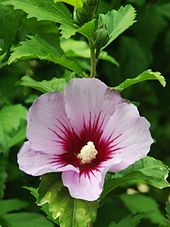 Though it has no autumn color and can be stiff and ungainly if badly pruned, H. syriacus remains a popular ornamental shrub today, with many cultivars. William Robinson mentioned several varieties in The English Flower Garden that are still available today. Triploid varieties were first produced at the National Arboretum, Washington DC, by Dr. D. Egolf, resulting in plants that bloom lavishly, as they are sterile and set no seed; Egolf varieties named for goddesses include the outstanding white 'Diana'. Also in the market are 'Lady Stanley', 'Ardens', 'Lucy', and 'Blushing Bride'.
Hibiscus syriacus is fairly easily propagated from either seeds, with variable results, or by layering or cuttings, cloning the original.


No comments:
Post a Comment